
High-stakes Course Redesign
I led this high-stakes course redesign to set a new standard for digital learning.
Project: Pilot postgraduate Masters course in business analytics
Role: Senior Learning Designer and design lead
Context: Transition to in-house design capability and new LMS
Outcome: TELAS Diamond rating and highest student feedback scores
Context and Challenge
My organization was undergoing a strategic shift from externally developed online courses to in-house ones, alongside the trial of a new LMS. I led a full redesign of the project’s pilot course, rebuilding its structure, content, and feedback model to test new ways of working, new quality standards, and a new learner experience design framework.
While the existing course was academically sound, it required uplift to meet expectations for digital learning at scale. The learner feedback from earlier offerings consistently pointed to gaps in contextualization, uneven depth of content, and limited formative feedback.
There was heightened scrutiny on this pilot course, as it would be submitted for external TELAS review focused on digital learner experience. Failure would have undermined confidence in the new in-house capabilities and the trialed LMS. Success needed to demonstrate not just an improved learning experience, but a repeatable, high-quality approach that could be applied across future offerings.
My Role and Scope
I led the learning design team responsible for the pilot course, working closely with the project manager, subject matter experts, senior academic leadership, and governance stakeholders to lift quality while maintaining academic integrity and industry relevance.
Beyond the course itself, I also contributed to the development of the learner experience design framework and associated workflows, making design decisions that set expectations for structure, feedback, and learner engagement across future courses. This meant balancing the immediate needs of the pilot with longer-term considerations.
The redesign moved well beyond content migration from one LMS to another. The focus was on re-establishing the course as a coherent, learner-centered digital experience, and establishing foundations for future courses. I integrated multiple competing priorities to design a coherent digital learning experience.
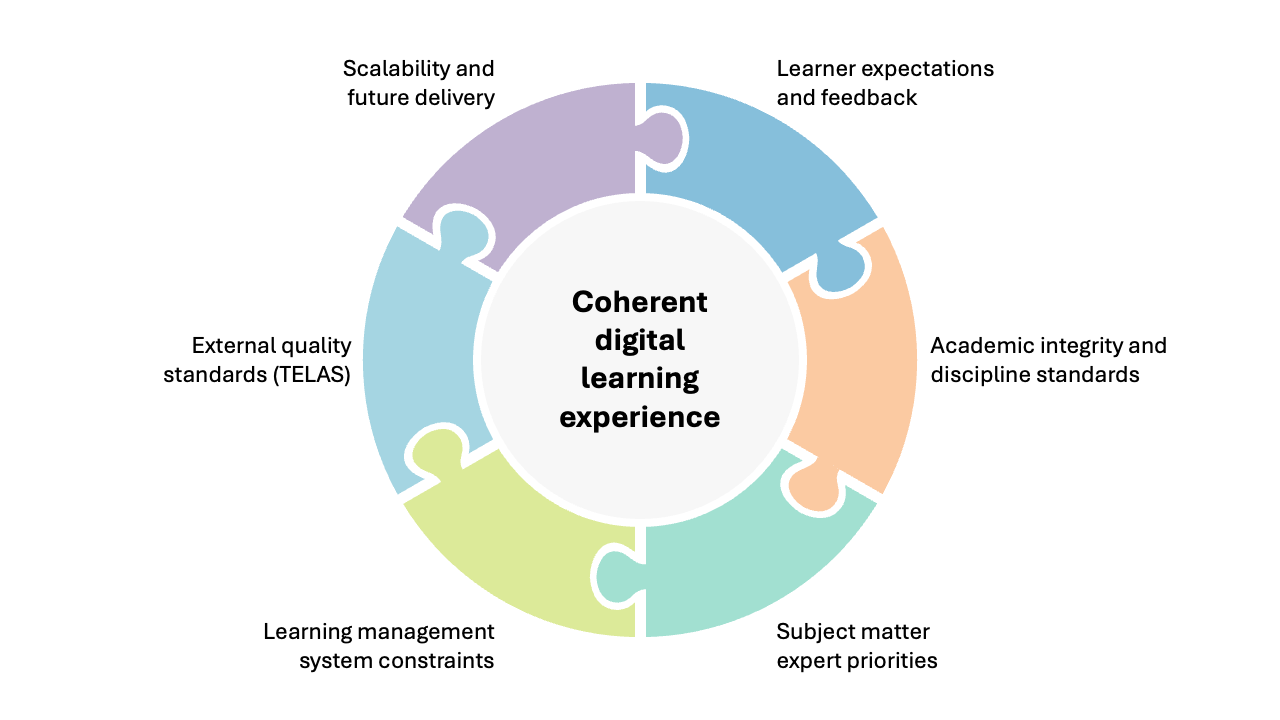
My contribution to the pilot included the following design and leadership work:
Collaborated closely with SMEs and academic leadership to significantly strengthen contextual framing in the course, ensuring learners understood not just what they were learning but why it mattered in professional practice
Improved communication about the existing course structure, making weekly patterns, and activity timing accurate and explicit
Advocated for a more authentic, developmental framing of assessment to reflect real-world communication expectations
Introduced debate-style discussion prompts to shift discussion to active exchanges of perspectives
Made design decisions based on evidence from student and teaching staff feedback, supporting purposeful, responsive refinement of the learning experience
Introduced design templates that were treated as living artefacts rather than static documents, each updated in response to design decisions, reviewer feedback and emerging patterns across the course
Reframed in-team reviews as collaborative problem-solving rather than fault-finding, creating a shared focus on quality, clarity, and learner experience
Outcomes
Quality outcomes were measured through two distinct processes: an external TELAS review focused on digital learner experience, and student feedback data collected across course offerings.
TELAS Diamond Rating
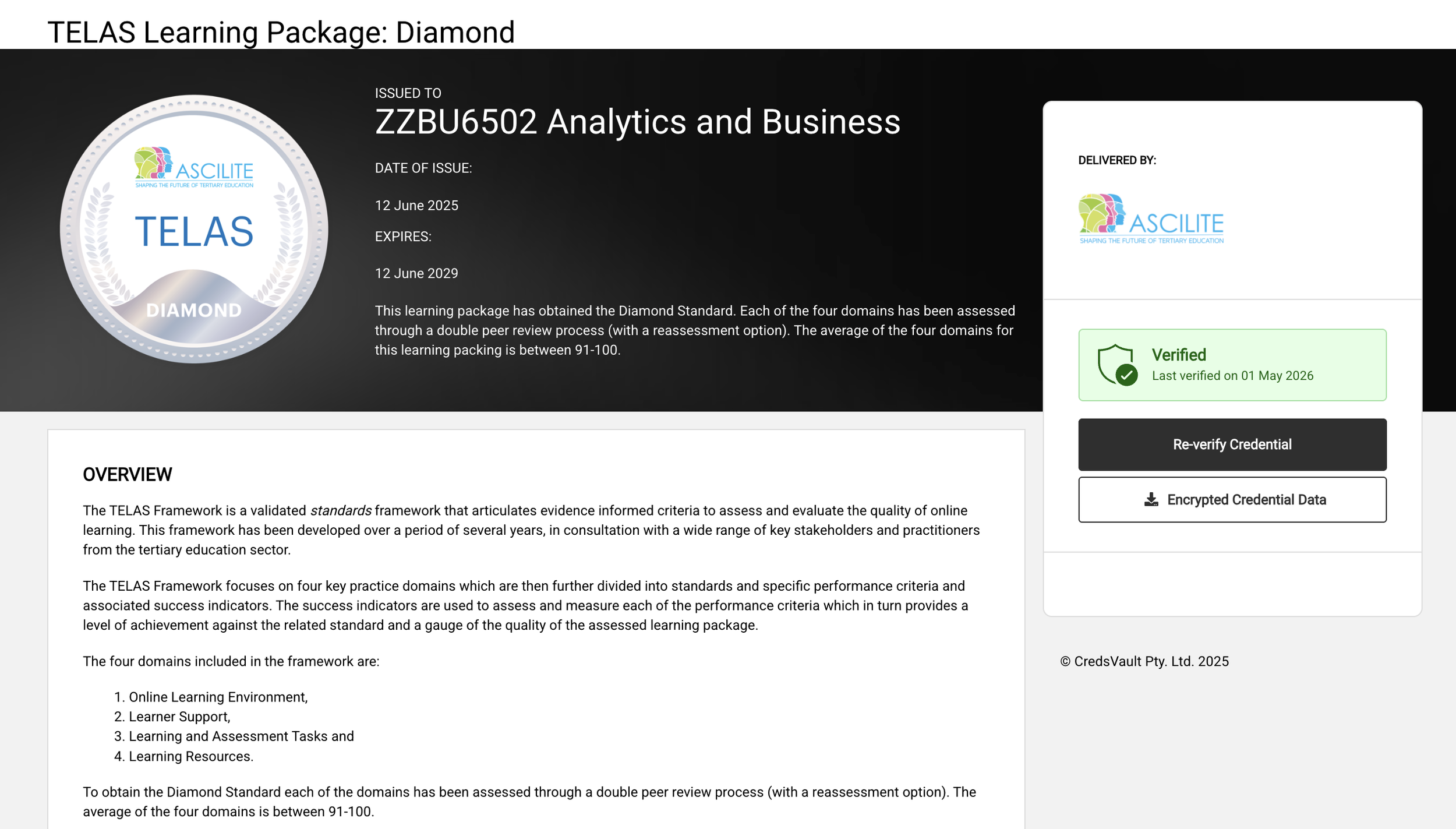
The course was submitted to Australia’s Technology Enhanced Learning Accreditation Scheme (TELAS) — an externally administered, internationally benchmarked quality review of digitally enhanced learning.
TELAS assessors evaluate courses against a validated set of criteria across multiple domains, and our redesigned offering received a Diamond rating, the highest possible outcome, indicating strong alignment with best-practice quality standards
Significant Uplift in Student Feedback
Student feedback collected after the redesign represented the strongest performance recorded across eleven offerings of the course, when compared with feedback from earlier iterations.
Agreement that the new course met overall quality expectations, supported learning through assessment, and provided appropriate learning resources exceeded 94%.
Compared to previous offerings, measures of strong agreement increased substantially, with gains of up to 23.5 percentage points, indicating not just satisfaction but increased confidence in the redesigned experience.
These outcomes validated both the course-level redesign and the broader learning design approach being trialed through the pilot.
Reflection
This project clarified something that has continued to shape my approach to digital learning design: quality emerges from coherence rather than complexity. The most meaningful improvements in learner experience came not from adding more splashy features or content, but from consistent structure, purposeful scaffolding, and sustainable approaches to feedback and interaction.
The pilot also reinforced the importance of building quality into the way teams work. Establishing living templates and constructive peer review practices enabled consistent, maintainable delivery across a multi-designer environment.
Leading the pilot also strengthened my approach to design leadership, particularly in balancing experimentation with disciplined decision-making and aligning diverse stakeholder expectations. It reinforced the importance of knowing when to pivot based on evidence or delivery constraints, while maintaining clear direction.
I’d love to work with you.
If you need an instructional designer or eLearning developer, contact me via email at drjaynewilkins@gmail.com or on LinkedIn.